All 361 exported frames, in their original order at 24 fps · 15.04 seconds · 1080p web copy of the 4K export. This software view shows the quarter-domain fields; the yellow hero animation separately reconstructs symmetry and interpolates time samples.
ANTENNA FDTD STUDIO · APPLICATION EXAMPLE
Inside the Band 3 reflector.
Explore the Band3 Deep28 860mm model through its original software views: circular-waveguide feed, recorded fields, port response and exported radiation patterns.
01 · MODEL SETUP
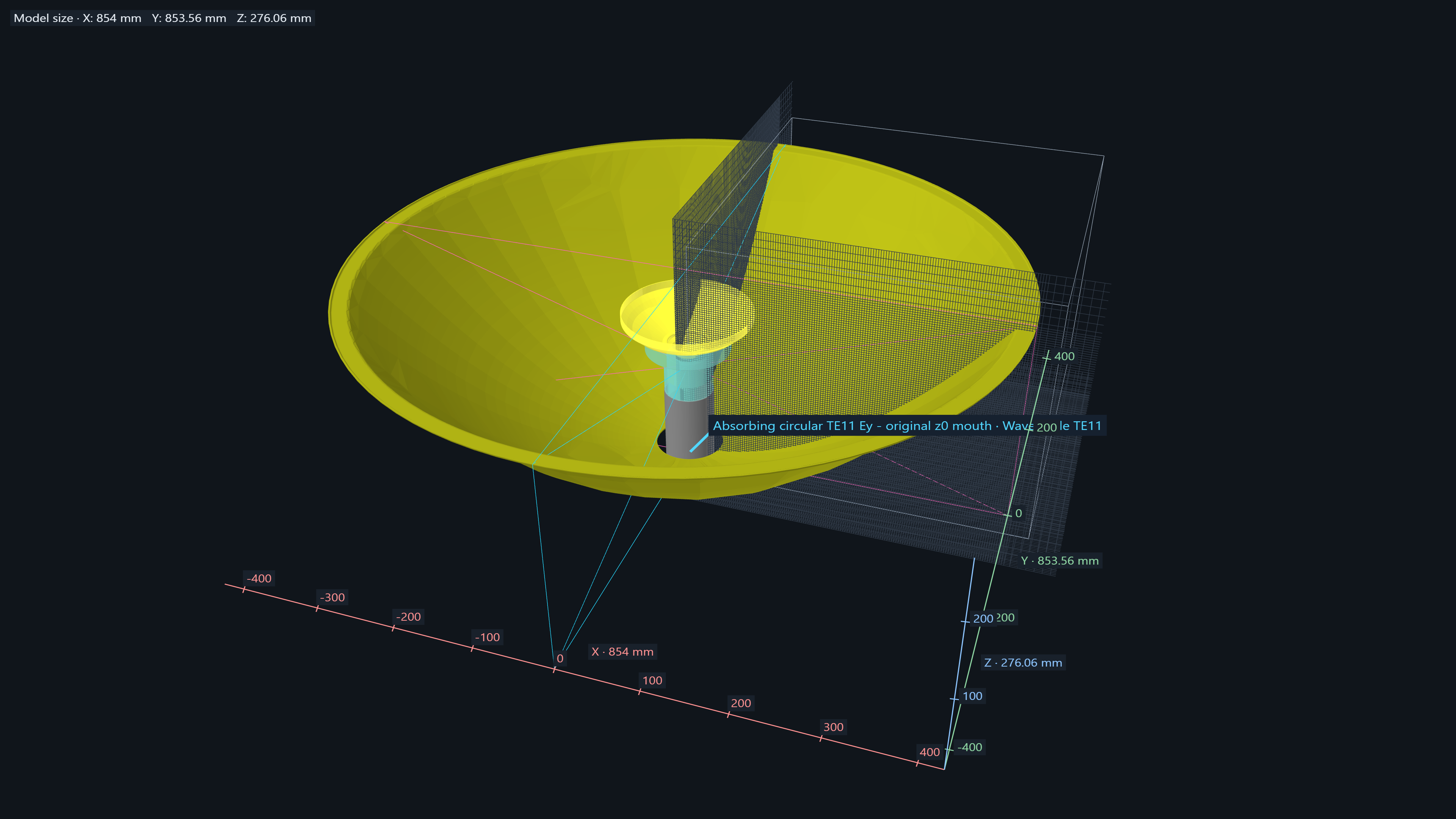
The reflector and its feed.
A nominal 860 mm reflector with a circular-waveguide TE11 feed and Ey polarization. The supplied workspace retains the geometry, port settings and model dimensions.
02 · RECORDED FIELDS
Watch the exported field evolve.
03 · PORT RESPONSE
Matching across 3.0–3.7 GHz.
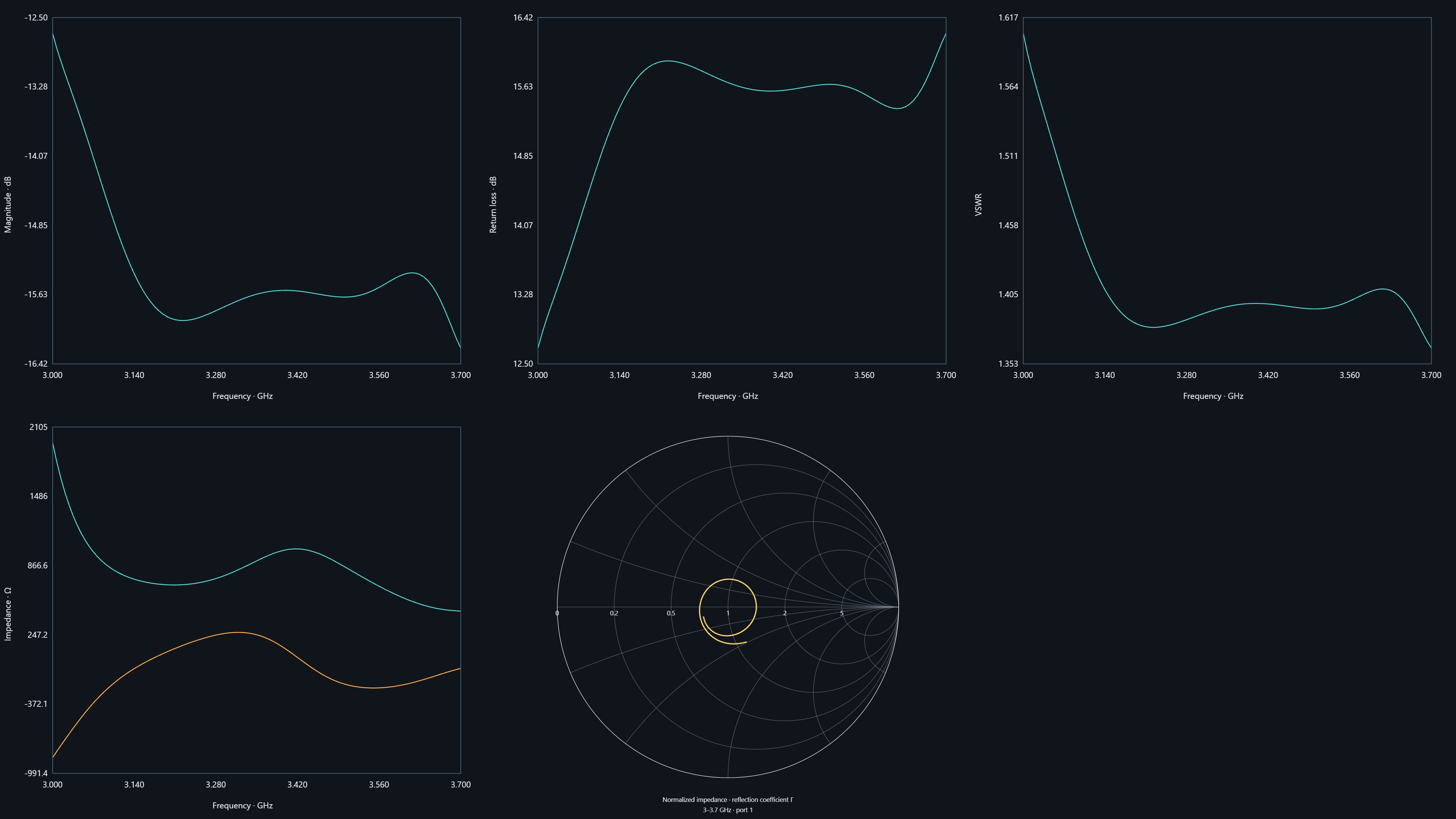
The accompanying archive records 101 frequency samples: S11 from −16.239 to −12.680 dB and VSWR from 1.365 to 1.605. These are simulation outputs for this model.
04 · EXPORTED RADIATION
The recorded radiation outputs.
The discrepancy with CST is unresolved; the figures are presented as recorded simulation results, not measured or convergence-validated antenna performance.
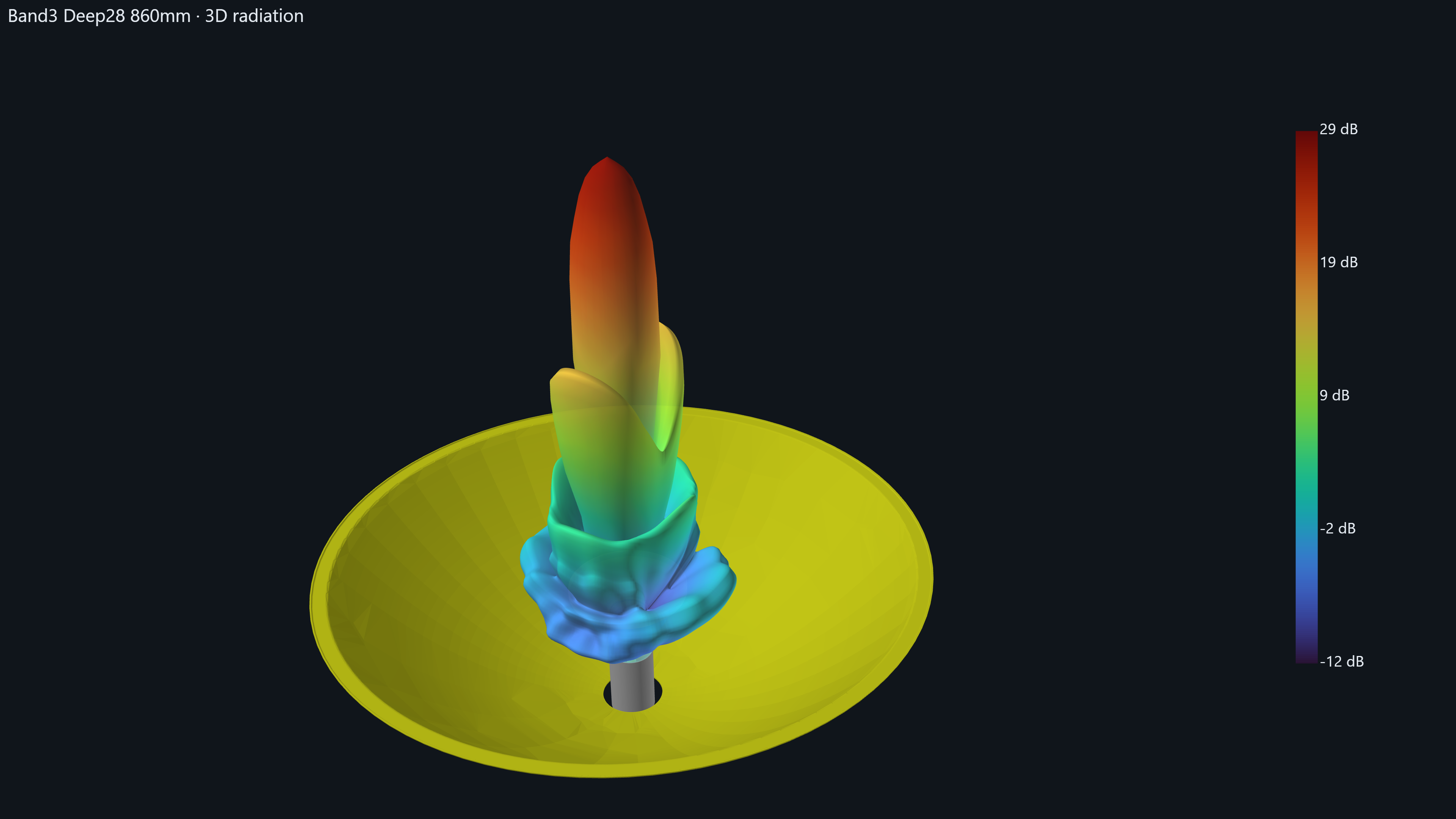
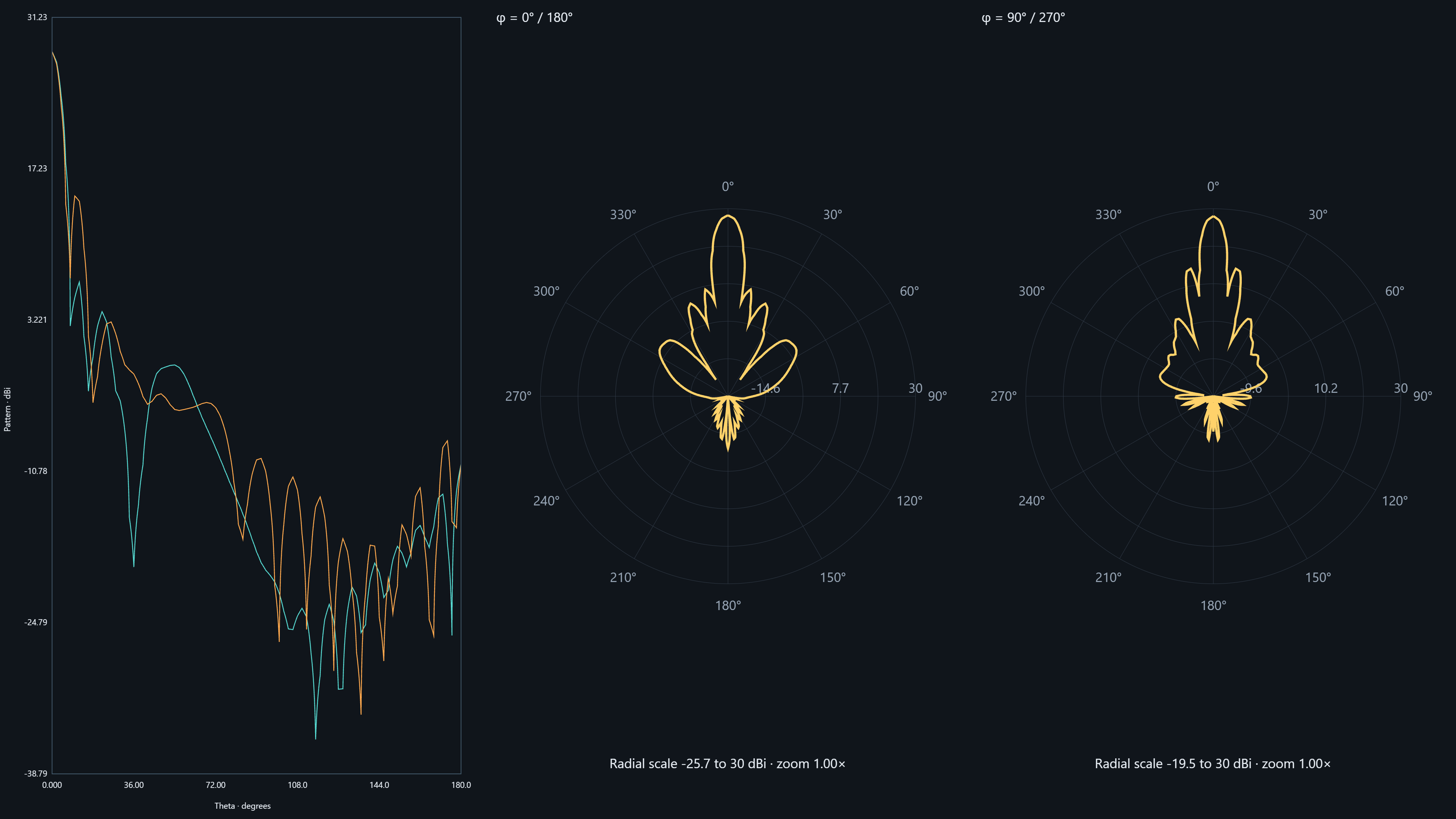
Separately, the supplied archive reports at 3.5 GHz: directivity 28.048 dBi, gain 27.904 dBi, realized gain 27.738 dBi, radiation efficiency 96.748% and total efficiency 93.124%. The screenshots do not independently identify their evaluation frequency.
05 · DATA & MODEL NOTES
Keep the results in context.
The supplied export titles identify Band3 Deep28 860mm and are consistent with the accompanying archive. The image and video files contain no independent run identifier, so their exact run association is not independently certified.
The archive uses a 465 × 465 × 328 graded mesh (70,921,800 cells), an ABS lens modeled with εr = 2.4 without dielectric loss, and two symmetry planes. The run ended after 8,651 steps at 14.994 ns with a recorded residual-energy level of −50.045 dB. That stopping criterion alone is not a convergence study.
Additional limitations include underresolved brass skin depth and circular-boundary checks limited to 3.2–3.6 GHz. The 7 MHz output grid does not imply independent spectral resolution; the recorded duration corresponds to approximately 66.69 MHz.
Original simulation exports; playback is not a live simulation. No measured-performance claim is made.
Back to Antenna examples